
Japanese language learning, rebuilt for travel
Learn travel-ready
Japanese
in just a few days
Learn Japanese by hooking every word to an English sound you already know and an image you cannot unsee. No kanji drills, no grammar tables, no textbook you abandon in week three.
No spam. Free forever for waitlist users.
- better recall
- 6×
- travel scenarios
- 50+
better recall
travel scenarios
10 words, 5 minutes
and they stay put
Japan-ready in days
no kanji required

The real problem
Why Japanese defeats most beginners
Japanese is not a difficult language to pronounce or to build sentences in. It is a difficult language to remember, and almost every course attacks the wrong half of that problem.
Three writing systems at once
Hiragana, katakana and a few thousand kanji. Most courses make you clear all three before you are allowed to say anything useful, which is where beginners quit. Travelingo teaches the sounds first, so you can order dinner in week one.
Almost no words you recognise
French gives an English speaker thousands of free cognates. Japanese gives you a handful. Every word is genuinely new, so raw repetition is slow. Memory hooks give each word something familiar to hang on.
Politeness changes the words
The same sentence shifts depending on who you are talking to, and textbooks drown you in the theory. You only need the polite register as a visitor, so that is the only one we drill.
Rhythm matters more than stress
Japanese is timed in even beats rather than stressed syllables, which is why romaji read with an English accent often does not land. Every phrase comes with native audio you can copy out loud.
Visualize better
Images that burn into your memory.
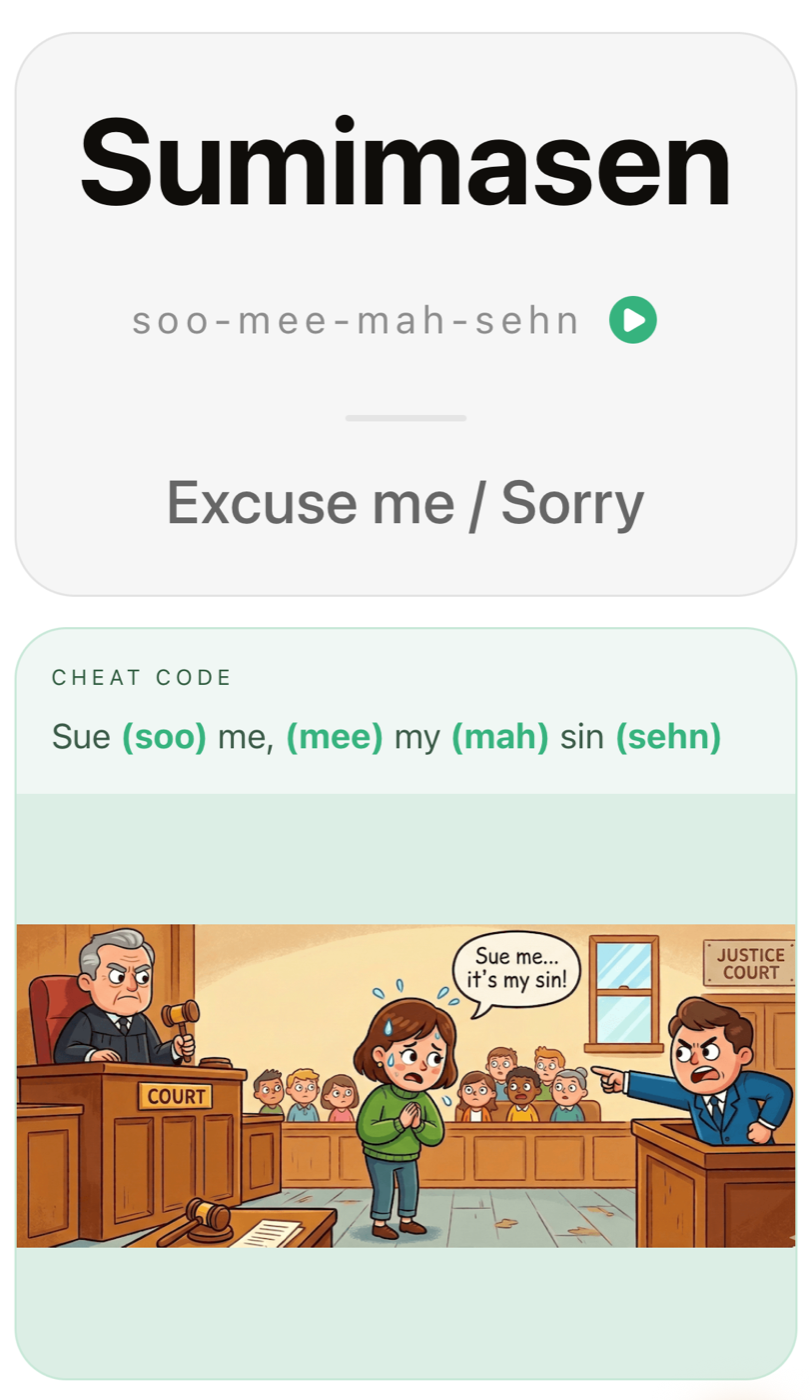
Sumimasen stops being four foreign syllables the moment it becomes “sue me, my sin” and a picture you cannot shake. Every Japanese word in Travelingo ships with a cheat code like that, plus the artwork to hang it on.
- Listen to the pronunciation in a native accent
- Humans recall photos 6x better than words
Trip-specific chapters
Learn Japanese for the
trip you are taking
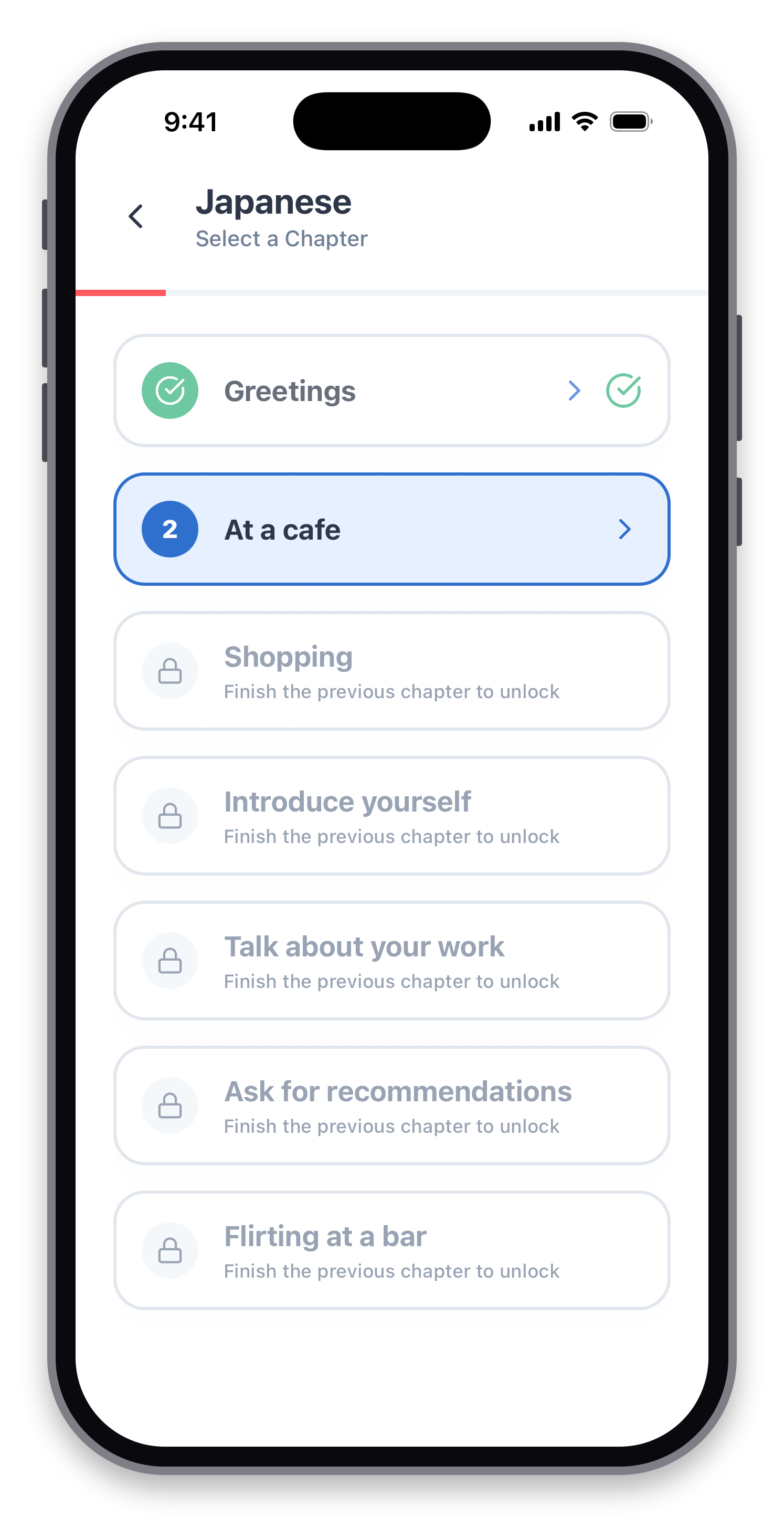
Chapters run from Greetings and Ordering Food through Trains, Convenience Stores and Flirting at a bar. You learn how to ask for the platform, read a set menu and pay at a counter, in the order you will actually need them.
- No native script required, the focus is speaking
- Offline support so you can revise on the flight
Daily practice
Five minutes a day,
hard to forget
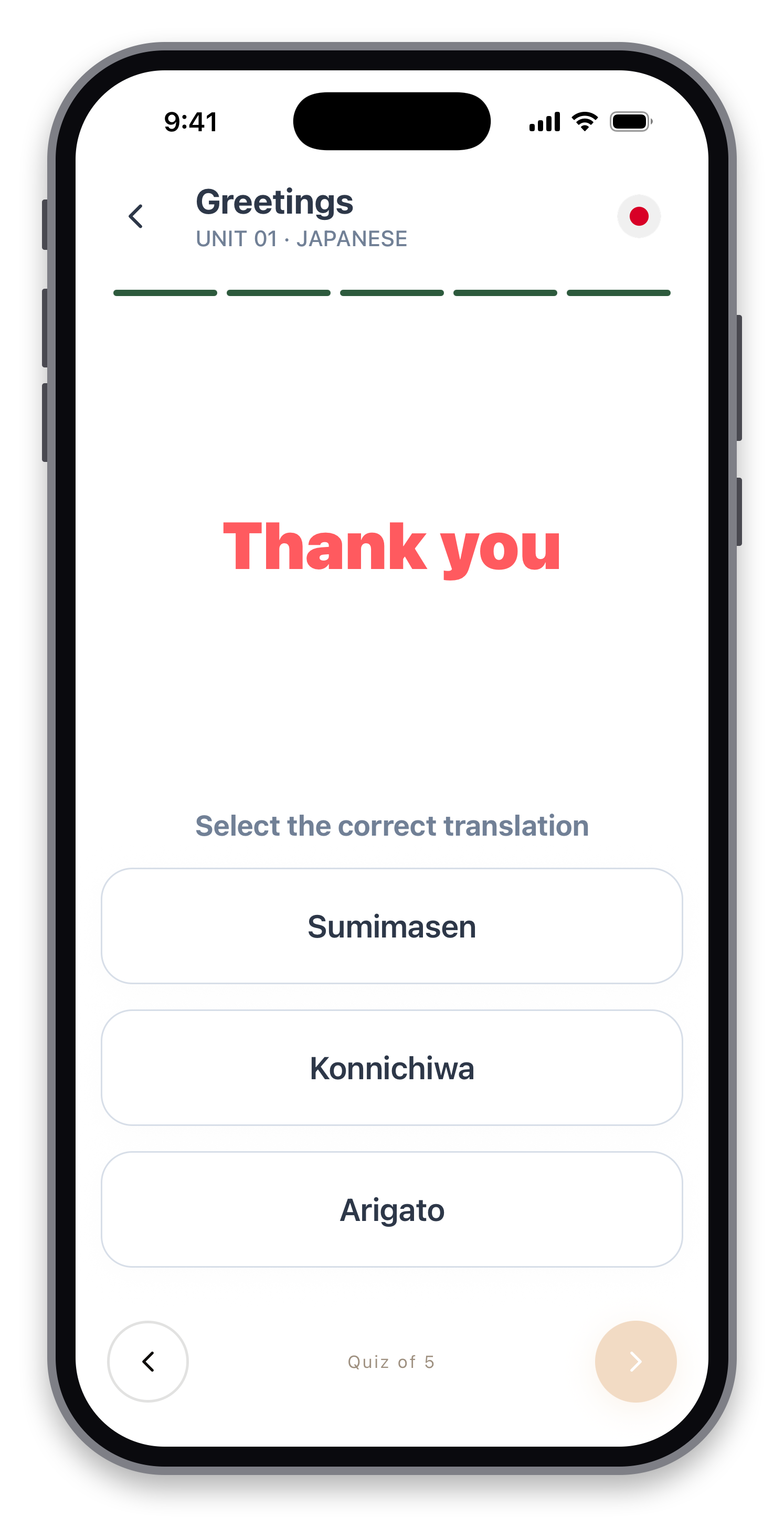
Quick quizzes bring each Japanese word back just before you would have lost it, with native audio on every prompt so your ear learns the rhythm alongside the meaning. Streaks keep you honest without it ever feeling like homework.
- Native pronunciation on every phrase
- Playful repetition instead of flashcard grind
Sound like you belong
Japanese pronunciation is the easy part
Japanese has only five vowels and they never drift: a as in father, i as in machine, u as in flute, e as in bed, o as in more. Learn those once and you can read any romaji in the app out loud without guessing.
The one habit worth breaking early is English stress. Every Japanese syllable gets the same length and the same weight, so a-ri-ga-to is four even beats rather than the ah-ree-GAH-toh an English speaker reaches for. Keep the beats even and you will be understood on your first try. Every phrase in Travelingo carries native audio for exactly that reason: your ear learns the rhythm before your mouth has a chance to invent one.
FAQ
Japanese language learning questions
The things people ask before they start, answered honestly.
Is Japanese hard to learn for English speakers?
The sounds are easy and the grammar is regular, with no genders, no plurals and no verb agreement. What makes Japanese slow is the writing and the near total lack of shared vocabulary with English, so there is nothing familiar to anchor a new word to. Mnemonics supply that anchor artificially, which is why they work so well for this particular language.
How long does it take to learn enough Japanese for a trip?
For a holiday you need roughly 100 to 200 words and about thirty set phrases, not fluency. At ten new words a day that is a fortnight of five minute sessions. Travelingo is built around exactly that goal: the phrases you will actually use at a station, a counter or an izakaya, rather than a curriculum designed for a classroom exam.
Do I need to learn kanji to speak Japanese?
No. Kanji is a reading and writing skill, not a speaking one, and Japan is unusually generous with romaji and English signage in the places visitors go. Skipping kanji at the start lets you spend every minute on words you can say out loud. If you later want to read, the spoken vocabulary you already have makes learning the characters far quicker.
What is the difference between hiragana, katakana and kanji?
Hiragana and katakana are two 46 character alphabets that both spell out sounds: hiragana for native Japanese words and grammar, katakana mostly for foreign loanwords like コーヒー (coffee). Kanji are borrowed Chinese characters that carry meaning rather than sound, and there are a couple of thousand in everyday use. Written Japanese mixes all three in the same sentence.
Is Travelingo useful for the JLPT?
It is not a JLPT course. Travelingo targets spoken, situational Japanese for travel rather than the reading comprehension and grammar analysis the exam tests. That said, the vocabulary overlaps heavily with N5 and N4, so it is a fast and painless way to build the base layer before you pick up a dedicated exam textbook.
Does it work offline while I am in Japan?
Yes. Chapters download to your phone, so you can revise on the flight, on the Shinkansen or anywhere your roaming gives up. Native pronunciation audio and the quizzes work without a connection too.
Don't be a tourist in Japan. Be a traveler.
Join the waitlist and be the first to learn 10 Japanese words in 5 minutes.
No spam. Free forever for waitlist users.